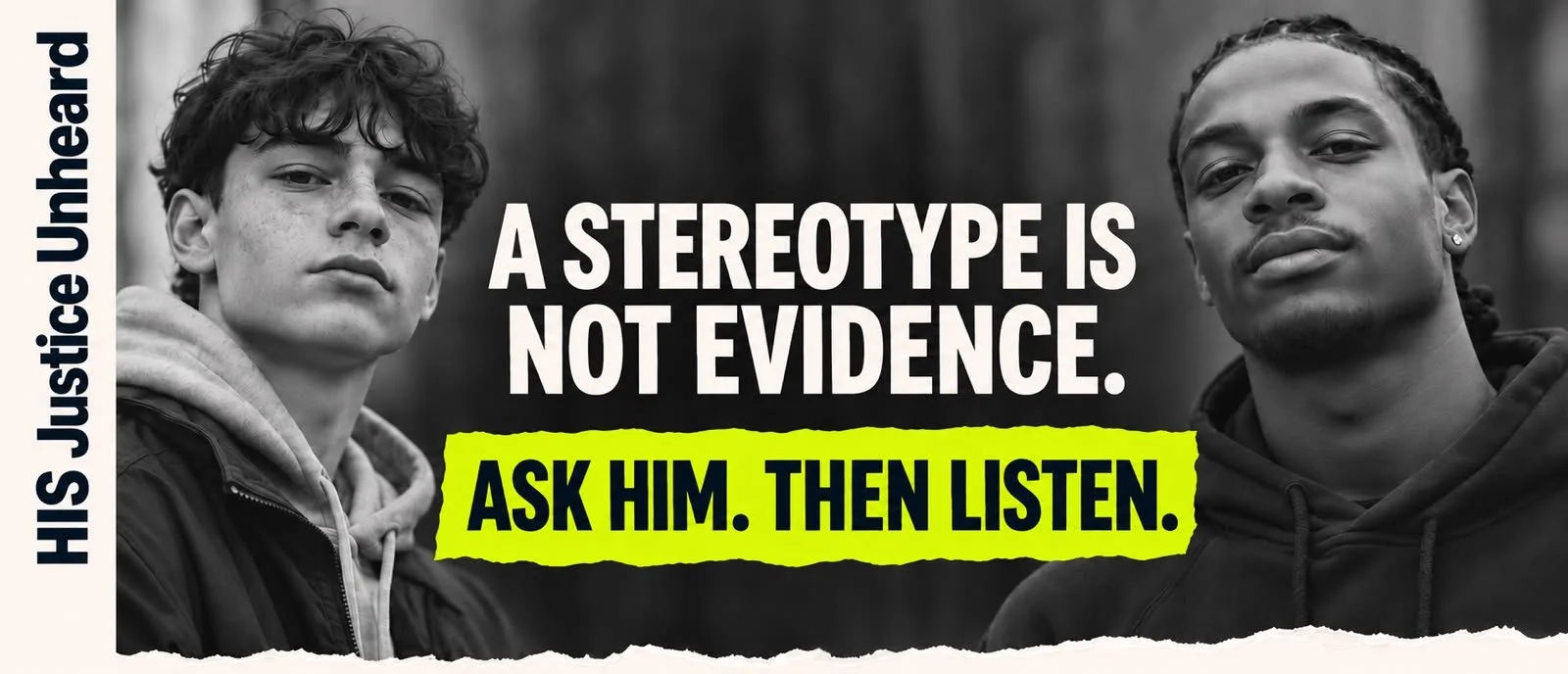
A guilty verdict doesn’t strip you of your humanity. Prison may take your freedom, but it must never take your rights or silence your voice.
HIS Justice Unheard
HIS Justice unheard
Everyone is innocent until proven guilty. Yet too often, once an accusation is made, a young person is treated as guilty long before any trial. That principle should shape how he is handled from the moment of arrest through to release, not just the verdict at the end.
HIS Justice Unheard stands with boys and young men aged 15 to 25 in the criminal justice system in England and Wales. They make up the large majority of young people arrested, charged and held in custody. Many are neurodivergent, have been through trauma or have complex needs that too often go unnoticed.
A young person who can't keep up with a fast interview, misreads a question or shuts down under stress is not being difficult. He may simply not understand. When nobody notices, it can shape what he says, how he is judged and what happens to him next. We exist to make sure he is understood and heard in his own words.
What we stand for
• Dignity from arrest onwards, with every step explained in words he understands
• No prejudgment: an accusation is not a conviction, and no young person should be treated as guilty at interview, charge, court or in custody before the facts have been tested
• Safeguarding at every stage for under-18s, with children's social services brought in early where needed
• Proper recognition of vulnerability in young adults aged 18 to 25
An accusation is not a conviction
Once an allegation is made, a young man can lose his liberty, his education, his job and his reputation long before any evidence is tested in court. Delays, remand and failures to disclose evidence mean some spend months or years paying a price for something that has not been proven. We stand for a system that takes every allegation seriously and treats every accused person as innocent until the facts say otherwise.
The problem with the law as it stands
The safeguards for children and vulnerable adults in police custody rest on guidance, not law, and too often they fail without consequence. Appropriate adults exist on paper, but too often they are volunteers with good intentions and little training. Spotting vulnerability is left to the judgement of the custody officer, with no required screening. We are challenging that.
What we are calling for
• The appropriate adult safeguard put on a statutory footing for vulnerable adults as well as children
• Every appropriate adult trained to a mandatory national standard in safeguarding, neurodiversity, ADHD, attachment and trauma, and available whenever police need them, day or night
• Compulsory screening for neurodivergence and communication needs at the point of arrest
• Regular wellbeing checks in custody by independent health professionals
• Real consequences when these protections are not met
A young person deserves someone in the room who understands him, and who knows when to ask for a question to be explained, a movement break or an interview to be stopped.
Training
We are developing practical training for police and custody staff in recognising and responding to neurodivergent young people, so that understanding starts the moment a young person walks through the custody door.
Beyond the case
Our support doesn't end at the court or the prison gate. We help young men prepare for release, reconnect with family and community, and rebuild education, work and a home. For those released without charge or found not guilty, we recognise that an accusation can do damage long after the case ends, and we help them move forward.
How we work
We gather evidence, listen to young men and their families, and work with police, lawyers, health and social care professionals and Parliament to turn what we learn into practical change.
Fairness for all
A fair process for the accused takes nothing away from victims. A justice system that gets it right for young men gets it right for everyone